FEUILLETON
NEVER OF INTEREST
The story of one window, one goose and a hundred and forty-five inquiries
I. THE WINDOW
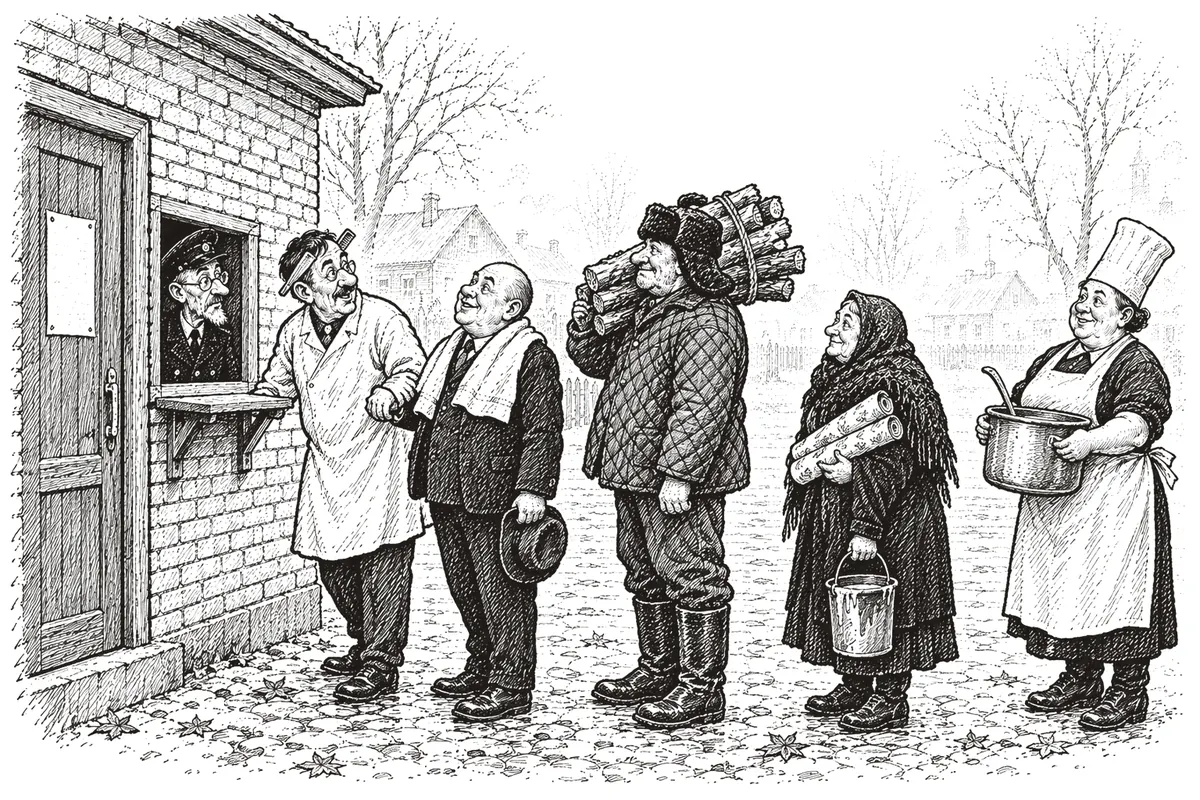
Window Number Three of the Uproshchensk Revenue Inspectorate had seen everything. For thirty years it had looked out on Revenue Square and asked a single question: “How much did you get?” It was answered in a whisper, with feeling and with a certificate. Citizen Vitrina, who sold geese at the market, answered with a sigh. The window accepted the sigh as well.
It asked about nothing else. In Uproshchensk one paid on one’s income, and that was considered enough. Income was the state’s business; spending was the family’s.
On Wednesday, the eleventh of November, at twenty to seven in the morning, a fog settled on the town. It had no intention of getting up. The fog and the road to the regional centre are two quantities which in Uproshchensk depend on no news whatever.
At ten past nine Senior Inspector Arkady Ilyich Vnikaev sat down behind the window: a man with a wedge-shaped beard and a job title longer than himself, Temporarily Permanent Commissioner for Questions Not Previously Asked. He unfolded the newspaper. The tax service, consultants reported, had begun checking the expenses of businesses on the simplified “income” scheme, the very thing that had “never been of interest” to it before.1 The inspector put the paper down not without a certain interest.
“And what did you spend it on?” he asked through the window.
There was nobody in the square. But the question had been asked, and the window could no longer take it back.
II. THE INQUIRY
By ten o’clock Vnikaev had sent out a hundred and forty-five inquiries: to every person and organisation in town that had money. In writing they read: “Kindly confirm your expenses for the past period by six this evening.” Orally, handing the paper to Ekranov the barber, the inspector added:
“Eau de Cologne especially.”
Whoever failed to confirm was due a claim. In Uproshchensk claims are written by hand, in triplicate. A hundred and forty-five claims make four hundred and thirty-five sheets and one hand. The hand was Vnikaev’s.
A notice appeared on the door, also handwritten. It was meant to read “Receipt of Confirmed Expenses”. The third word would not fit on the sheet.
RECEIPT OF EXPENSESFROM THE PUBLIC9 to 6, Window No. 3
The town read what was written. By eleven there was a queue of forty-two people at the window, handing in expenses. A resident of Aggregate Street handed in his outlay on firewood and asked for it not to be returned. The widow Lenta handed in last year’s repairs and went away travelling light.
“We don’t take expenses,” Vnikaev replied. “We confirm them.”
“With what?”
“With results.”
The rule was carried out to the letter. Ekranov brought along a freshly shaved client; the client was examined and added to the file. The canteen confirmed yesterday’s lunch with the testimony of those who had lunched. The testimony agreed in every particular except the compote. In the queue people said: “Not confirmed, not an expense.”
By noon eleven inquiries had been closed. A hundred and thirty-four inquiries remained, and six hours.
III. FIVE THESES
Across the square from the inspectorate there had stood for thirty years a savings bank. It too had a window, and that window asked the opposite question: “How much are you taking out?” The one window knew where the citizens’ money came from, the other where it went. Neither shared with the other.
At noon the manager of the savings bank, Ksenofont Petrovich Tezisov,2 came out on to the porch and proclaimed five theses. He spoke in placards.
“The window is an interface. The interface is dead! The bank of the future is invisible! Pay only for results! Not a kopeck to the middleman! An agent for every citizen!”
The bank’s window was boarded up with plywood and the sign taken down. In the fog the bank had been hard to make out even before; now this became a principle. Tezisov himself materialised only at the moment of a transaction: a citizen reached for his purse, and out of the fog came the manager, took the money and went back again.
The theses contained the words “A.I. agent”. Uproshchensk found four citizens with the initials A. I. and put them to work. Anton Ivanovich Sdelny, formerly an agent for the procurement of down and feathers, knew the client’s preferences, budget, history and goals. Avdotya Ignatyevna from the welfare office knew the anniversaries as well. The agents walked past the shop windows without looking and bought things in seconds.
The one to suffer from this was the foreign platform Euroaggregate,3 through which the town had done its shopping until Wednesday. It took twenty-five kopecks in the rouble and did not sell galoshes at all: it rented them out, by the month. Anton Ivanovich went for his galoshes straight to the factory.
The inspectorate fared worst of all.
“What did you spend it on?” Vnikaev kept asking.
“I don’t know,” the citizen would honestly reply. “The agent spent it.”
The agent could not be caught, the bank could not be seen, and no receipt existed. On the door of the former savings bank hung a review.
★★★★☆Couldn’t find the bank. Or my money.Satisfied with the service:nobody was rude to me.
At one o’clock Vnikaev put on his galoshes, took his briefcase and went out into the fog. The invisible bank shows itself at the moment of a transaction. Consequently, a transaction was required.
IV. THE GOOSE
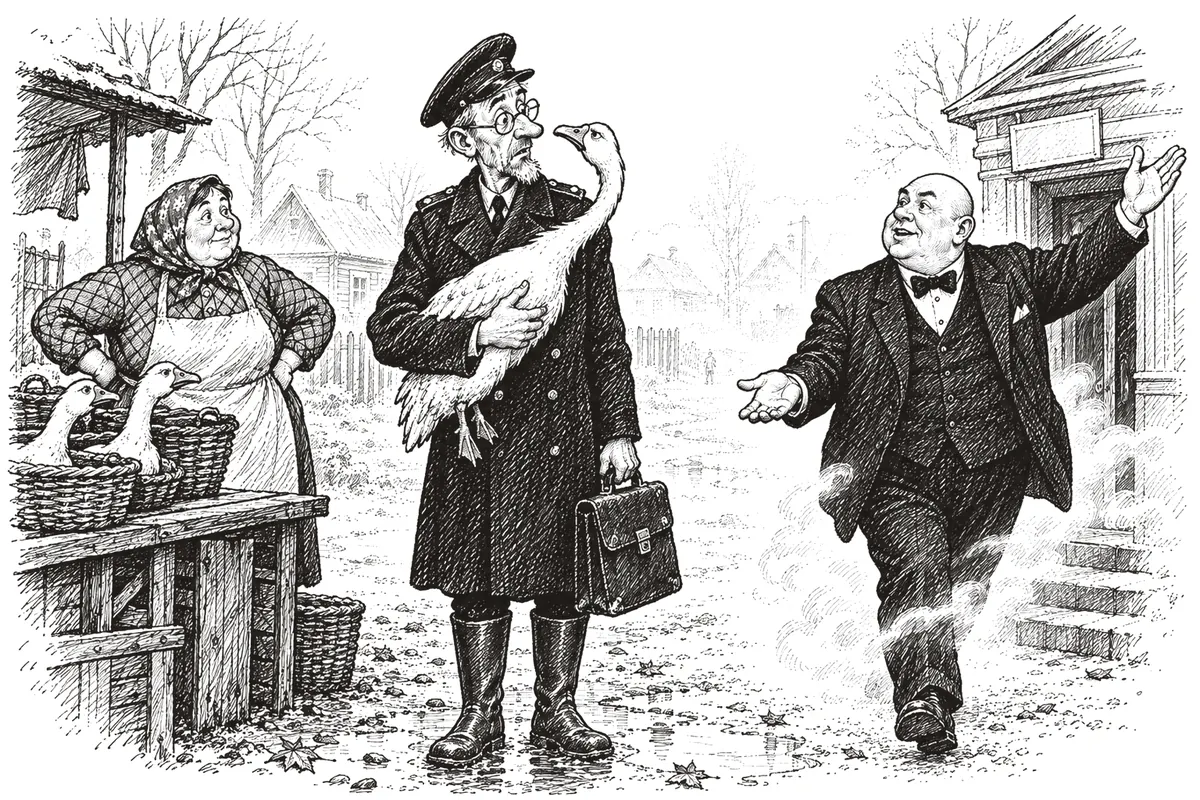
On the inspector’s briefcase stood, in brass letters: “A. I.” At the market this proved sufficient.
“Are you A. I.?” Citizen Vitrina asked out of the fog.
“A. I.,” said Vnikaev, a truthful man.
“Then it’s yours. Ordered this morning.”
And into his arms was laid a goose: alive, warm and displeased.
The senior inspector had bought nothing for eleven years: his wife did the buying. He stood holding the goose for forty seconds, which for an agent is unforgivably long. Then the fog parted and out stepped Tezisov.
“Transaction completed! Two thousand four hundred, if you please! Payment for results! The result is under your arm!”
Vnikaev paid and held out his hand.
“Receipt.”
“The bank is invisible. So is the receipt.”
“Then how am I to confirm the expense?”
Tezisov said nothing. He was not silent for long, but in such a way that it became clear the question had now been put to the inspector. Then he went off into the fog.
Arkady Ilyich was left standing in the middle of the market with a goose and an unconfirmed expense. He took out a form and made out inquiry number one hundred and forty-six, to Citizen Vnikaev, A. I., same deadline. He served it, signed for receipt and realised that he had nothing to answer with. There were no inspectors left in Uproshchensk. There were only the inspected.
The goose looked at him the way the window had looked for thirty years.
V. THE PACKET
At twenty to six a packet was pushed through Window Number Three, addressed “To the Body Receiving Expenses from the Public”. The packet was foreign, new and duly agreed.
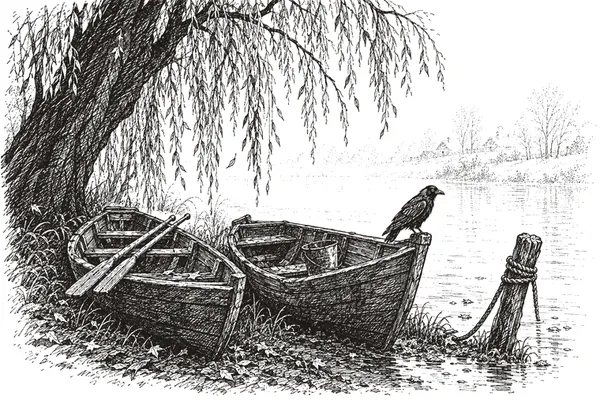
It had been sent by Euroaggregate. The platform’s permanent representatives, aggrieved at the agents, had agreed on a list: one hundred and forty-five persons and organisations of Uproshchensk whose right to rent anything from it would henceforth be restricted. Vnikaev counted them again. One hundred and forty-one persons and two institutions were listed for links to the financial system: each of them had a savings book. First came he himself, second Tezisov. The boating station was listed as a shadow fleet: both its boats have lain in the shade under a willow since June. The bench outside number six was held responsible for spreading false information: it was there that someone had said the goose would get cheaper.
Below, in small print, it said that the list would be discussed on Monday. One could be struck off sooner by confirming one’s expenses to the platform for the past three years. A subscription service, nine hundred and ninety a month. From the cover a representative smiled. His smile was worth exactly nine hundred and ninety.
Vnikaev reread the postscript and, for the first time that day, took offence.
“Nobody was ever interested in what Uproshchensk spends,” he told the goose. “Since this morning I am. It does not follow that anyone with an envelope may take an interest.”
Then he thought for four and a quarter minutes and took up his stamp. Expenses can be restricted only for those who have them. The foreign party certified in writing, over its signature and with a smile, that one hundred and forty-five persons and organisations of Uproshchensk spent money, and spent it visibly. The inspectorate had not received better confirmation in thirty years.
At two minutes to six all hundred and forty-five inquiries bore the words: “Confirmed. Interested party.” The packet was filed. The town later held that the list had done the most harm to whoever drew it up: the paper alone had run to a hundred and forty-five names.
No claims had to be written. There remained inquiry number one hundred and forty-six. The goose did not appear on the foreign list.
VI. THE FOG
At six o’clock sharp Citizen Vitrina came up to the window.
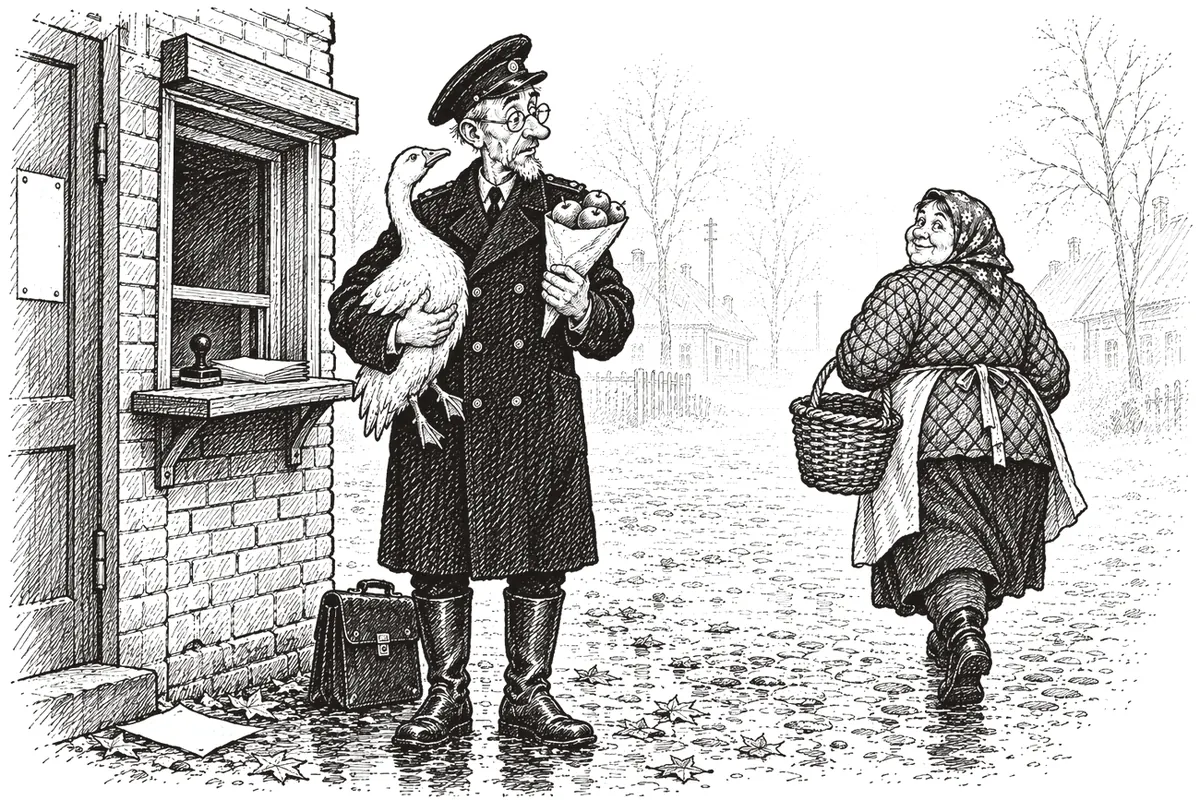
“Your wife’s agent, Avdotya Ignatyevna, ordered that goose for you this morning. For your thirty years of service. It was paid for. And you paid a second time.”
She laid two thousand four hundred roubles on the window sill.
“We don’t take twice for one goose. We’re not a platform.”
To the money she added a bag of Antonovka apples. Vnikaev asked how much he owed. Nothing. He asked whether she needed a receipt. Citizen Vitrina looked at him as at a visitor from out of town and went off into the fog.
The inspector closed inquiry number one hundred and forty-six: “Expense returned. Apples are not an expense.” How his wife’s agent knew his anniversaries, preferences, history and goals he decided not to inquire. Family expenses were of no interest to him. As before.
By evening the notice on the door had grown damp and come unstuck of its own accord. Nobody stuck it back. The goose is scheduled for Thursday, with apples and a sense of legitimate expenditure.
The fog over Revenue Square stood as before. As before, there was no bank to be seen in it. Window Number Three looked out on the square and asked: “How much did you get?” It asked about nothing else. It saw everything without asking.
From press reports
Sources (RBC, 11 November 2026; in Russian):
- Tax service begins checking spending on business cards — rbc.ru/economics/11/11/2026/6af2e43e558414110ac4aa96
- Gref forecasts five trends of the platform economy for the next ten years — rbc.ru/economics/11/11/2026/6af483f150b80520ab29b039
- EU ambassadors agree a new package of sanctions against Russia — rbc.ru/politics/11/11/2026/6af48c73a0636aecebf941b7