FEUILLETON
IN ONE CLEAR VOICE
A tale of one Friday, one bass and one per cent, as told by eyewitnesses and the newspapers
I. THE BANDSTAND
The bandstand in the Kvartalsk city garden had seen everything. It had seen a brass band, a lecturer on the dangers of draughts, and forty years of singing rivalry between two quarters, the Third and Zarechye. On Friday it rained. The rain fell finely and neatly, like a report nobody was ever going to read.
The station buffet porter, Tikhon Yedinoglasov, wanted that bandstand. Tikhon had a bass that made the glasses in the buffet ring, even the empty ones. He wanted to sing for the Third Quarter and, for the first time in forty years, beat Zarechye.
“I won’t let you,” said his mother. “Singers end up in the buffet.”
“I’m already in the buffet. As a porter.”
“Then carry on carrying.”
“We’ve sung for forty years and lost for forty years,” his mother added. “It’s tradition. Leave it be.”
The town said Zarechye was getting ready: it had spent days arguing about who would sing on behalf of Zarechye.1 Tikhon said nothing and that evening took his application to the quarter council. The cat who lived under the bandstand looked out, assessed the weather and went back in.
II. THE COUNCIL
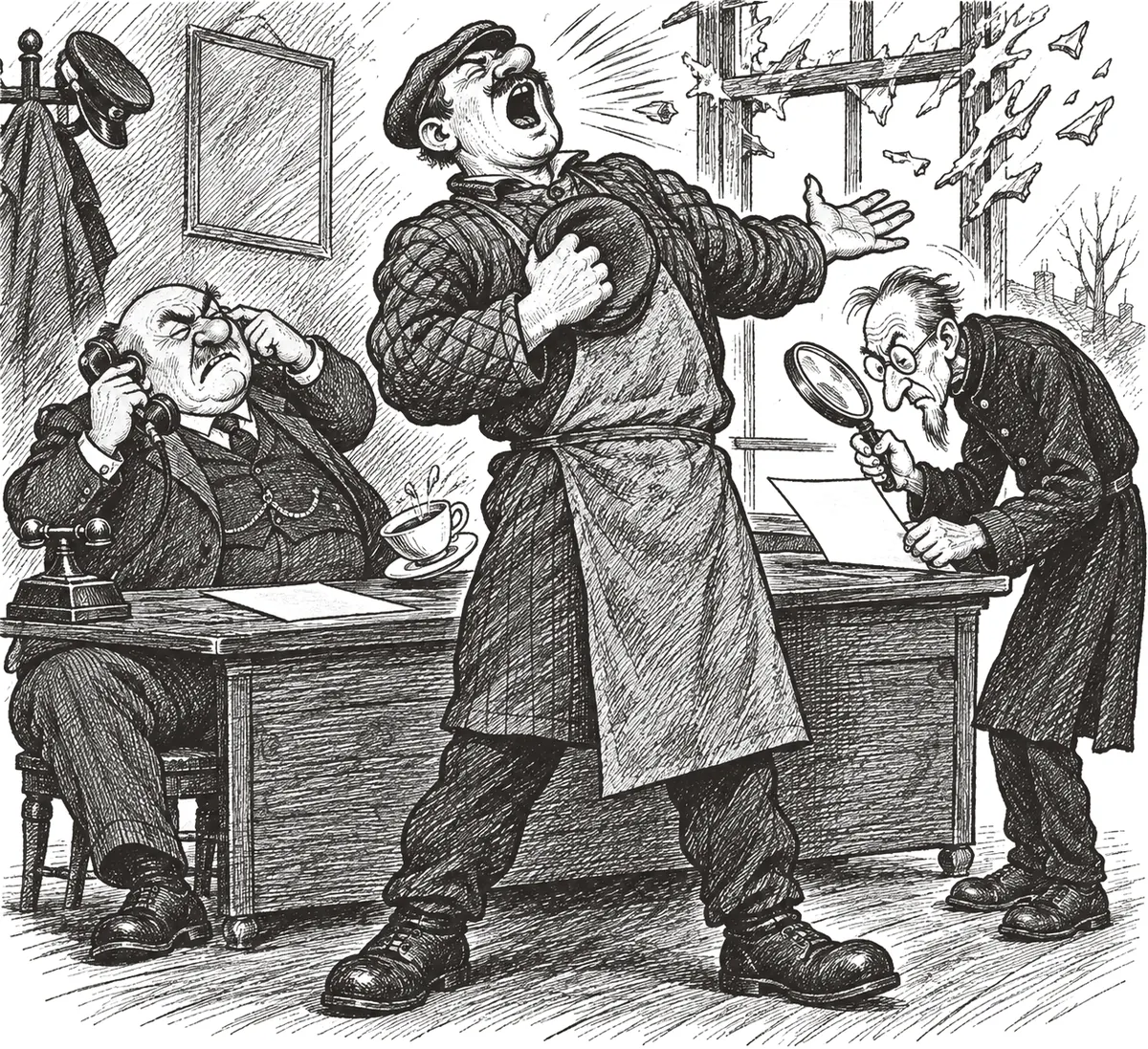
After the discipline inspections, the Third Quarter council consisted of two people: the chairman, Fyodor Ilyich Preyemnikov, and his deputy, a former calligrapher.2 The other five had dropped out. The deputy was kept on: a good deputy is hard to find.
The chairman was on the phone to the quarter’s former tenor. The tenor had sung in the Third for seven years, then left for the choir next door, but kept in touch.3
“Yes… Of course we remember… No, we’re not offering yet. But we’re not not offering either… No guarantees… None on your side either? Well then, we have a deal.”
Tikhon laid his application on the desk. The deputy studied not the voice but the handwriting.
“Cursive,” he said with respect. “Calligraphy teaches one thing: it’s not what you sing, it’s how you sign. Sing.”
Tikhon sang. The putty cracked in the window. The chairman hung up on the tenor without saying goodbye.
“The tenor didn’t refuse,” the deputy reminded him. “He’s thinking.”
“Nor did he agree,” said the chairman. “So he’s free.”
“The council has resolved to consider the council in agreement,” he announced.
III. THE FORMAT
Zarechye did not send a soloist. It sent a format: five advisers and two institutions, the bathhouse and the housing office.1 The advisers sang at technical level, that is, they opened their mouths. The institutions stood by, silent and tight, without gaps.4
“We sing with one clear voice,” said the format.
“Then why can’t we hear it?” someone from the Third Quarter asked.
“At technical level,” the format explained.
“Unity need not be loud.”
“There’s only one of me,” said Tikhon.
“That is your internal matter,” the format said politely.
Tikhon stepped out and drew breath. Then the deputy raised his hand: the name on the application was in cursive, and the regulations required regular script. While they hunted for the regulations, the rain ended the contest for everyone. The jury resolved to consider the contest a contest. Victory went to the format, for unity.
Tikhon went back to the buffet and began to live by the menu:
MENU“Upward Trajectory” salad“Plus Five Point Two” cutlet“PreliminaryEstimate” compote“E5” format: fivecutlets for seven
“What’ll it be?” asked the buffet lady.
“The estimate, please,” said Tikhon. “Preliminary. Hold the format.”
IV. THE ESTIMATE
A month later the quarter statistician pinned a preliminary estimate up by the buffet. Singing in the Third Quarter was up one per cent on last year; the earlier estimate had promised six tenths.5 Catering drove the growth: Tikhon sang in the buffet daily, from seven till closing.
His mother read the estimate twice, put on her galoshes and came to the buffet.
“You’re growing,” she said. “Even the statistician noticed.”
“By one per cent.”
“Since you sing anyway, sing where it counts. I’ve already got my galoshes on.”
She took him to the old station announcer, who had shouted over trains for thirty years and never been cut off.
“A voice is not a sparrow,” said the announcer. “Once it flies out, it gets counted.”
“And if it rains again?” asked Tikhon.
“Rain is not a jury. You outsing it.”
“I want a rematch,” said Tikhon. “I didn’t finish the last contest. The rain did.”
Zarechye agreed at once. The format was ready to sing any time, always the same.
V. THE RAIN
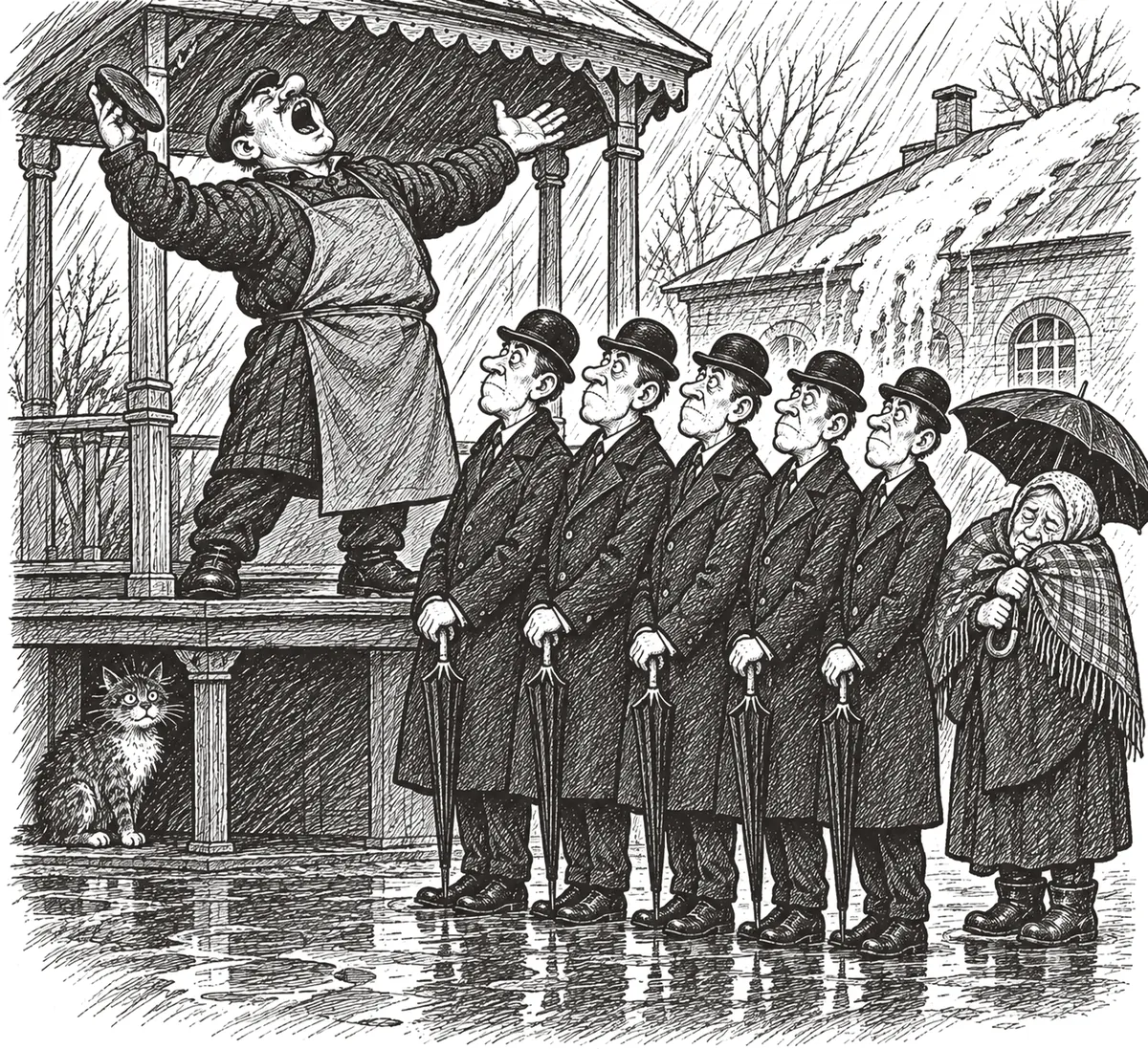
The format opened all its mouths at once. Tikhon sang. In the second verse his top notes went, so he sang the third on the bottom alone. The bottom was enough. Snow slid off the bathhouse roof, and the advisers shut their mouths and never opened them again, this time as a sign of agreement.
“And who’s that?” asked Zarechye.
“The per cent,” said his mother. “Our own.”
“The Third Quarter wins,” said Preyemnikov. “Unanimously.”
“We welcome the outcome,” said the format. “In close coordination and with deep respect for the bass.”
His mother stood under her umbrella and cried. It was the damp, she later explained. The cat came out from under the bandstand and, for the first time in forty years, sat through to the end. The road to Zarechye stayed as it had been forty years ago; no estimate touched it.
The rain over the bandstand in Kvartalsk fell as before, finely and neatly, like a report which, this time, somebody read.
From press reports
Sources (RBC, 13 November 2026, in Russian):
- Europe has chosen five countries for talks on Ukraine — rbc.ru/politics/13/11/2026/6af74362d09c06b2eb22c9d1
- NYT on the rise of the ‘military inquisitor’ after the purges in China — rbc.ru/politics/13/11/2026/6af73a7d8c5183ec0a3ac7df
- FT learns whom the Nvidia board approached in search of a new chief — rbc.ru/business/13/11/2026/6af75045c86601e34aaeb4c7
- The EU reveals how it plans to take part in talks on Ukraine — rbc.ru/politics/13/11/2026/6af74b4e40887869aaf286da
- Russia’s economy grew by 1% in the third quarter — rbc.ru/economics/13/11/2026/6af7345c12552b15b874a95a