FEUILLETON
TOO EARLY TO TELL
The tale of a certain Tuesday, as told by eyewitnesses and the papers
I. THIRST
In the district town of Preniev there were so many barber’s shops and parcel pick-up points that it seemed the inhabitants were born for no other purpose than to have their hair cut, collect a parcel and promptly send it back.
On Tuesday, the tenth of November, a third occupation was added to these quiet pursuits. The town was reading the news.
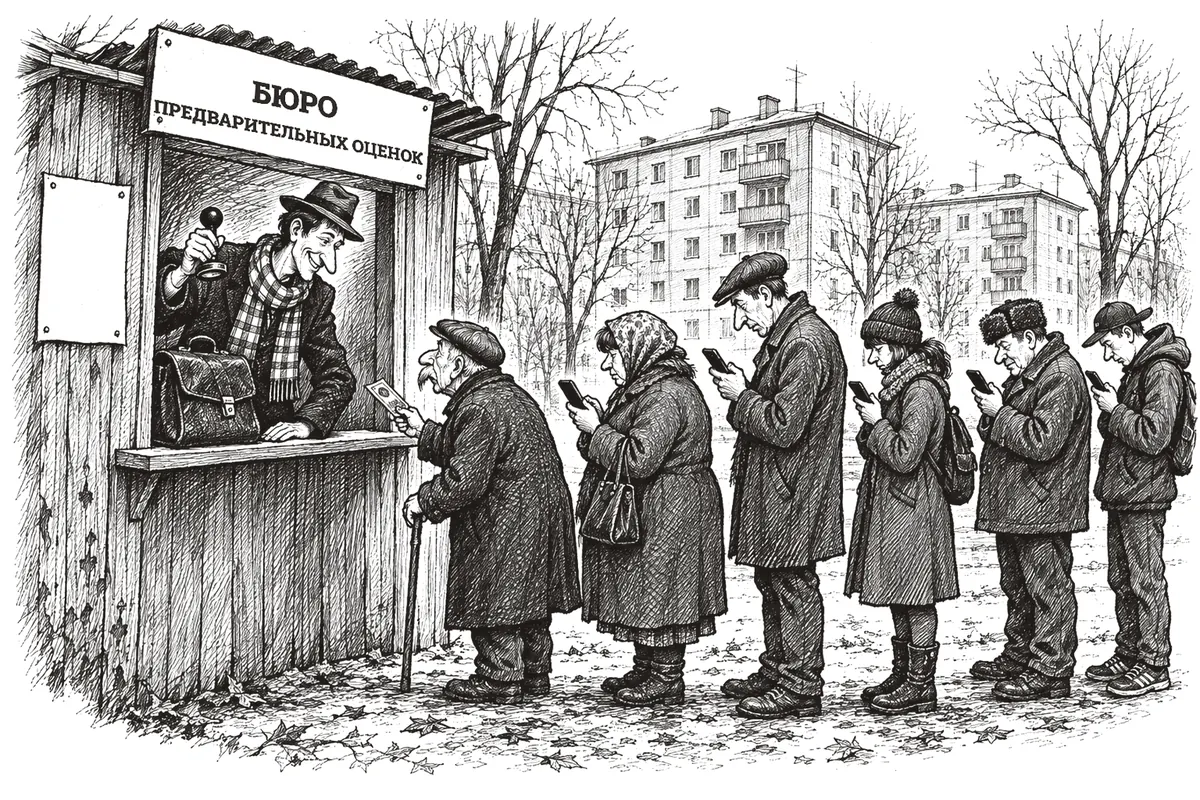
It read the news on its phones while queuing for parcels, and the longer it read, the more it languished. It was reported that two-day talks between Russia, Ukraine and the United States had opened in Abu Dhabi and that the first meeting had lasted more than four hours.2 It was further reported that the participants had made no general statements on its outcome, and that the Kremlin had refrained from forecasts.2 Finally, the Deputy Foreign Minister, Ryabkov, said that it was “too early” to judge the course of the talks, and confirmed that they would continue the next day.3
“Four hours they sat,” said the pensioner Yermolai Savvich Nebaba, a man whose moustache resembled two commas put in the wrong place. “Back in ninety-two I stood four hours in a queue for sugar, got to know the whole district and married off a couple. And now it’s ‘too early’.”
The queue hummed in sympathy. A Prenievite needed an assessment. Without one he felt like a man without galoshes in November: one can walk, but it is not cosy.
II. THE BUREAU
At that very minute a young man of about thirty-five in a checked scarf came off the platform of Preniev Goods Station and walked into the town. In his hand he carried a briefcase. In the briefcase lay a toothbrush, a round rubber stamp and a business plan begun in three places and finished in none. The young man’s name was Rostislav Kuzmich Obtekaev.
Obtekaev listened to the queue for a minute and a half. That was enough for him, as one glance at the patient’s tongue is enough for an experienced doctor.
“The citizens are languishing,” he said quietly. “The citizens need a formulation. The demand is there, but supply keeps mum and puts everyone off till tomorrow. That isn’t a market, that’s an orphan.”
By noon the boarded-up kiosk that had once offered “Shoe Repairs & Keys Cut” bore a cardboard sign:
BUREAUOF PRELIMINARYASSESSMENTSPrompt. Streamlined.Officially stamped
Below it hung a price list: a cautious assessment, one hundred roubles; a guardedly optimistic one, two hundred; an imported one, three hundred and fifty. The “too early” assessment was dispensed free of charge.
The imported assessment was not Rostislav Kuzmich’s own invention. He had borrowed it from the American Secretary of State, Rubio, who that day in Paris had called the talks “very productive” but stressed that a good deal of work still lay ahead.2
“A foreign article, and all-purpose,” Obtekaev explained, breathing on his stamp. “Suitable for negotiations, for home repairs and for married life. Will wear for years.”
The post of director general of the bureau went to Goga Pritykin, a local youth on whose face the expectation of an advance had set for good.
III. THE SKY OVER “DAWN”
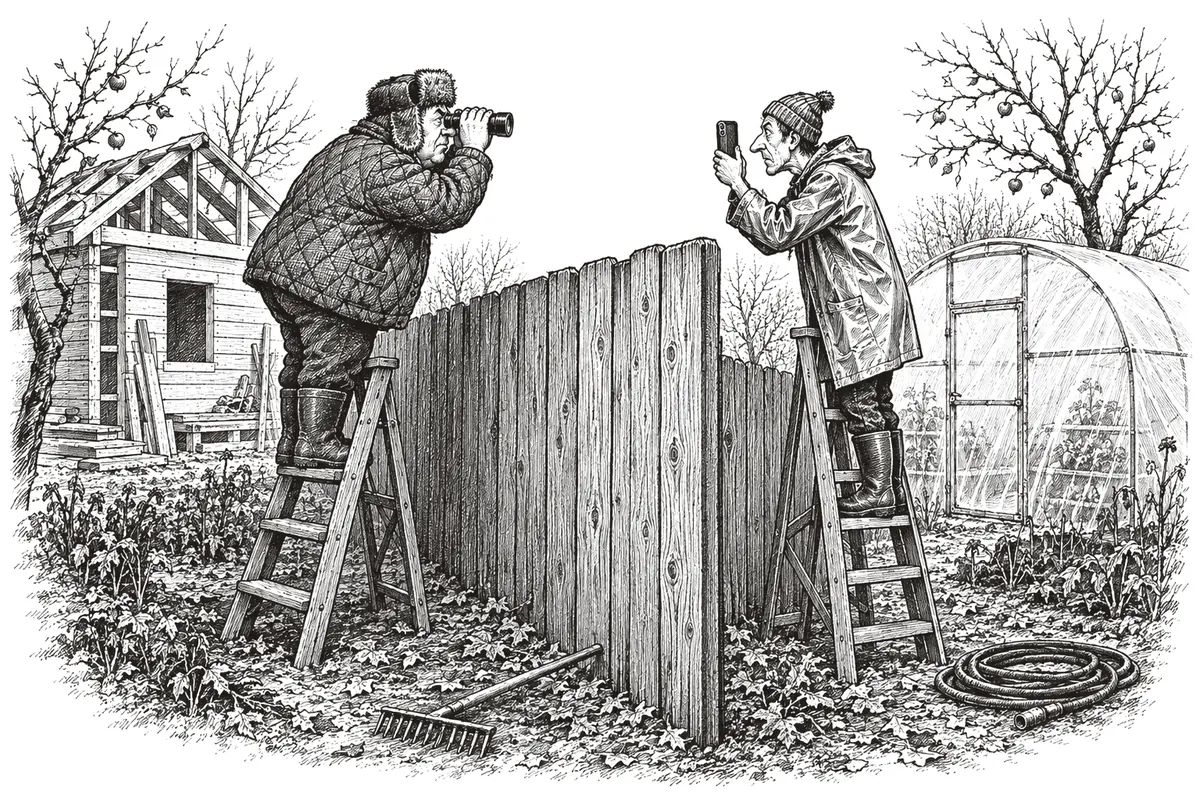
The first clients were the gardeners Kurdyukov and Syroezhkin of the Dawn allotment society. They had not been on speaking terms since nineteen ninety-two, that is to say, for exactly as long as the Treaty on Open Skies has existed, signed that year by representatives of twenty-seven states.1
Both had read in the news that, according to the Financial Times, the countries of Europe were ready to resume talks with Russia on arms control, even to the point of reviving such Cold War mechanisms as that same Open Skies and limits on the deployment of certain classes of missile.1
“So even Europe has come round,” said Kurdyukov, looking past Syroezhkin. “Whereas a neighbour of mine has been building a shed for six years now, and what is in that shed is unknown to science.”
“His own greenhouse looks suspicious,” replied Syroezhkin, looking past Kurdyukov.
Obtekaev drew up the treaty in forty minutes. Each party was granted the right to two observation ascents of a stepladder per week, with photography and filming of the adjacent vegetable beds. The deployment of certain classes of implement, namely rakes, tines up, and long-range hoses, within three metres of the fence was prohibited. The document was named the Open Stepladder Treaty.
“Trust, but climb and verify,” said Rostislav Kuzmich, and applied the stamp.
The stamp read: “Red Tinker Cooperative. For Delivery Notes.” Both sides went away satisfied, each to its own side.
IV. INTO BUSINESS
After lunch Nebaba read the news aloud to the queue. The state corporation Rosatom, having become the sole owner of the Delo group (the word means simply “business”), was pressing on with its reshuffle of the logistics holding: the port operator Global Ports was to get a new chief executive.4
“So even the atom has gone into business,” said Yermolai Savvich with respect. “I’m the only one on a pension.”
Obtekaev took the report as a directive. Being the sole owner of the kiosk, he too began a reshuffle at once: he removed Goga Pritykin from the post of director general and appointed him acting director general, on the same salary as before, there having been none.
“And what’s changed?” asked Goga.
“The architecture,” Obtekaev answered sternly. “This morning you were a figure. Now you are a mechanism.”
Goga felt more significant and asked for an advance. The advance was refused him in a suitably streamlined form.
V. THE TRILATERAL LIFT
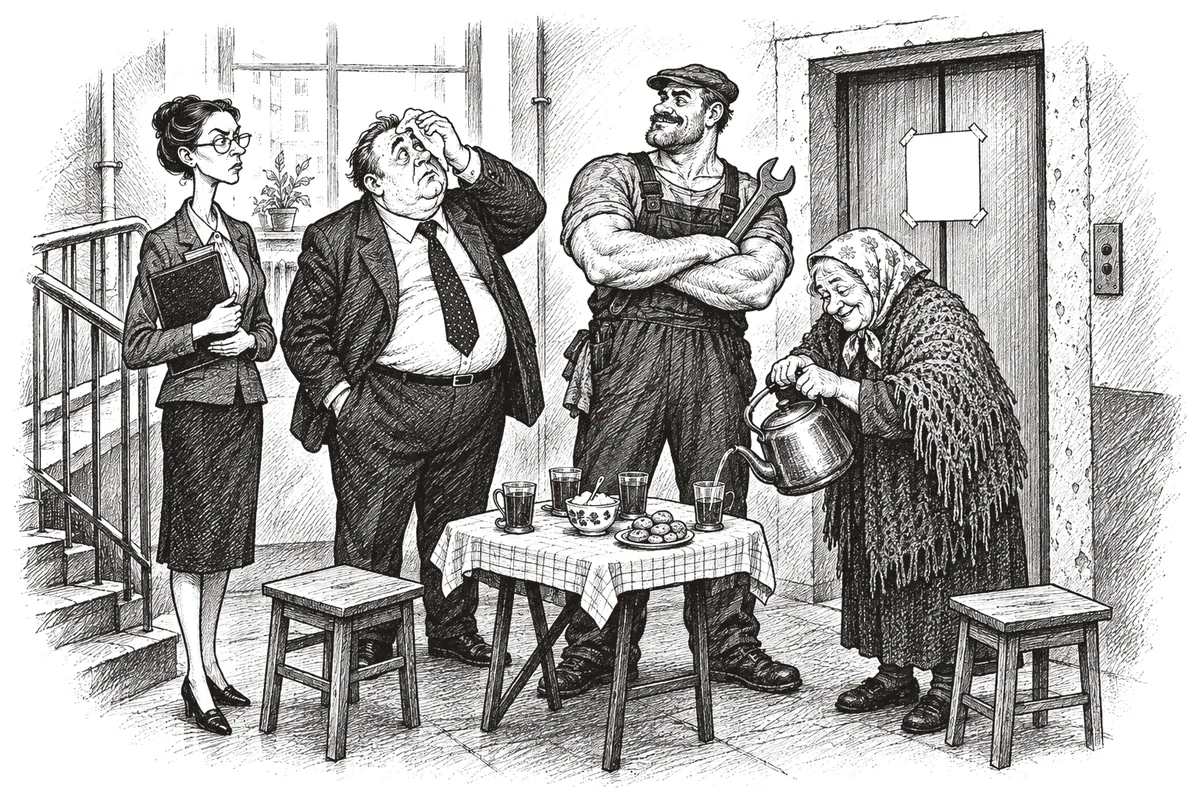
Towards evening the bureau received a large order. At number seven, Concord Street, the lift had been standing idle for going on three months. The residents demanded assessments. The management company, Cosy Prospects, gave none. Gavrilov the mechanic did give assessments, but of a kind that could not be printed.
Obtekaev proposed a trilateral format. The concierge, Adelaida Pavlovna, acted as host. She thanked the parties for the trust they had placed in her and assured them that she stood ready to provide all necessary support, by which she meant a kettle and two stools.
The first meeting lasted more than four hours. The parties discussed the security architecture of the cabin, guarantees for residents above the fifth floor and channels of communication in the event of a crisis, that is, the Call button. As in Abu Dhabi,5 the talks were conducted in Russian, a language in which Gavrilov the mechanic was especially fluent.
By then the town already knew that the Ukrainian president, Zelensky, had called the first day in Abu Dhabi constructive and fairly substantive, but had remarked that it was “hard going with the Russians”.5 So nobody was surprised when the residents’ representative, Zoya Vlasyevna, a bookkeeper, stepped out on to the staircase during the break and wrote in the building’s group chat: “Format constructive.” Aloud she added:
“It’s hard going with mechanics.”
The parties made no general statements on the outcome of the meeting. The lift likewise declined to comment.
VI. NO PRICE LIST
When darkness fell, the whole of Preniev gathered at the kiosk. It demanded a final assessment: of the talks, of the lift and of things in general.
Obtekaev came out to the people with the stamp in his hand.
“Citizens!” he said. “Let us not answer such questions, especially now, while the talks are under way. It is too early to tell. The bureau will resume its work tomorrow.”
The words were not his own. The first sentence had been spoken that day by the President’s press secretary, Peskov;2 the second, almost word for word, by the Deputy Minister, Ryabkov.3 But Rostislav Kuzmich had long held that a good formulation, like a good umbrella, belongs to whoever is holding it.
“Then what did we pay for?” asked Nebaba.
“For restrained optimism,” answered Obtekaev. “Made to order. Non-returnable.”
The crowd fell silent. Then Yermolai Savvich took off his cap and said very quietly:
“Just tell me one thing, Mister Formulator. Will there be peace?”
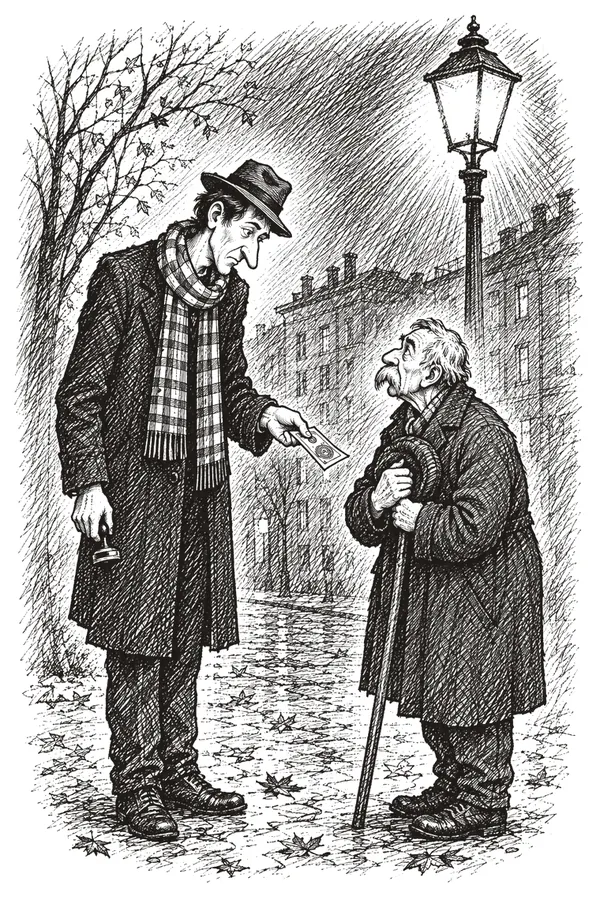
And then something happened to Rostislav Kuzmich that had not happened to him since his schooldays: he could not find a formulation. He stood for a while turning the stamp over in his fingers, then took out a hundred-rouble note and gave it back to the old man.
“There’s no price list for that, old man,” he said. “Let us hope.”
The same words had been spoken before the talks by the American envoy, Kushner: “Let us hope that this war will be the last one here.”2 The formulation proved to be a common one and, it seems, the only one all Tuesday that nobody thought to dispute.
The talks are to resume on Wednesday, the eleventh of November.2,3 The town of Preniev resolved to get up early, have its hair cut, collect its parcels and switch on the news.
From press reports
Sources (RBC, 10 November 2026; in Russian):
- FT learns Europe is ready to resume missile talks with Russia — rbc.ru/politics/10/11/2026/6af337f3b077b4a18bd4fa5e
- How the first day of the trilateral talks in Abu Dhabi ended — rbc.ru/politics/10/11/2026/6af327055ad3ef55b58353cf
- Foreign Ministry urges no rush to judge the trilateral talks in Abu Dhabi — rbc.ru/politics/10/11/2026/6af354e9aae0ebb74fc7de3c
- Rosatom continues its management reshuffle at the Delo group — rbc.ru/business/10/11/2026/6af3351ba3ffb564fa644410
- Zelensky says talks are “hard going with the Russians” — rbc.ru/politics/10/11/2026/6af33a8a19097e277f289294