FEUILLETON
A LEGEND SUCCEEDS A LEGEND
The story of one Thursday, one chair and four and a half hours, as told by eyewitnesses
I. THE NOTICE
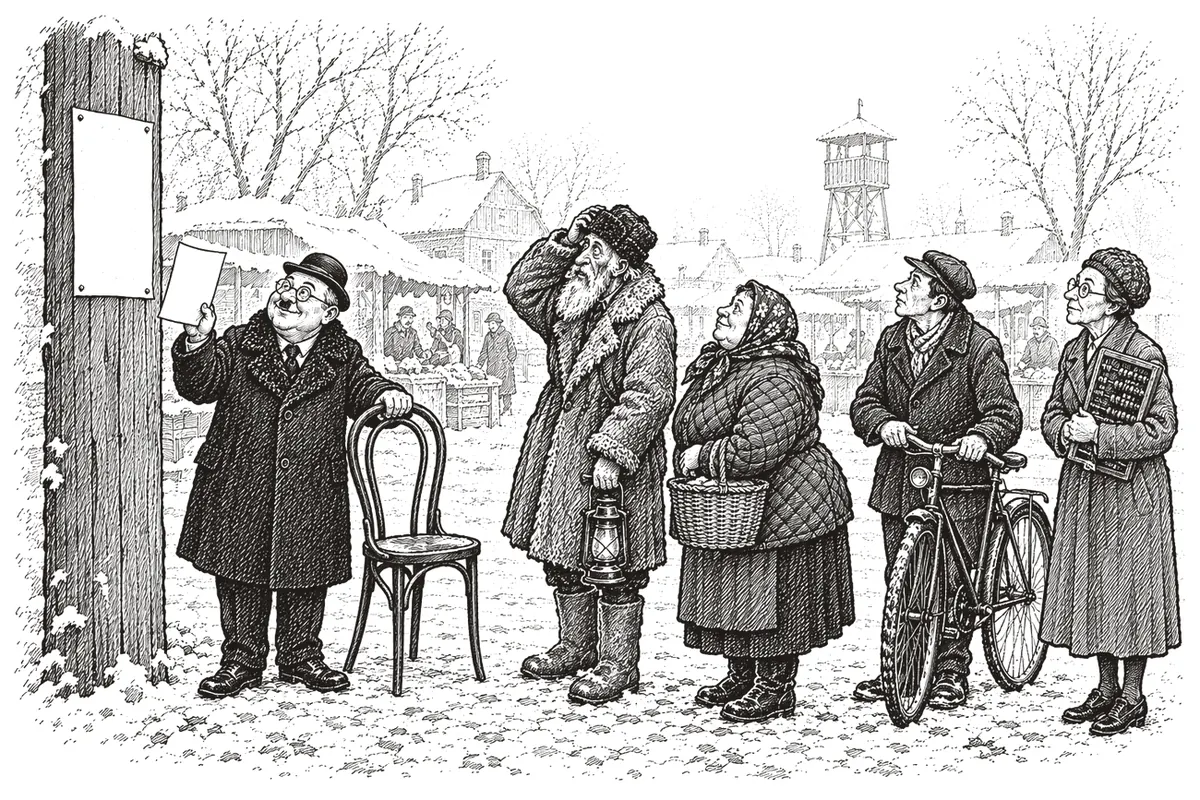
On the post by the market in Smeninsk a notice had been hanging since morning:
THE VIDOKARTA ARTELSEEKS ACHAIRMANPermanent.Candidates internaland external.Temporary persons are askednot to trouble themselves.Apply to:V. K. Podyskin
The notice was competently drawn up. Only one word in it was worrying: “permanent”. Nothing in Smeninsk was permanent except the weather and the artel itself.
The Vidokarta artel printed views of the town on postcards: the fire tower, the landing stage, the bathhouse in profile. On these postcards Smeninsk looked better than in life, but recognisable. By capitalisation it ranked second in the town, just after the Yabloko garden association.1 It had been founded in ninety-three by one man, who had run it for thirty-three years since. On Thursday, the twelfth of November, the board resolved that the founder would leave all his posts forthwith.1 The reason given was a story the town spoke of in an undertone and the minutes did not speak of at all.
The bookkeeper, Angelina Fyodorovna Sovmeshchenko, was appointed acting head. She was not relieved of the bookkeeping.1 She had been given a post with nothing taken away, and in Smeninsk this was considered rare generosity on the part of the management.
II. THE CHAIR
For the first time in the artel’s history a chairman of the board was required.1 The post went to Varsonofy Kuzmich Podyskin, a man whose face had frozen in the expectation of a quorum. The Vidokarta board of directors consisted of three people, and the only director among them was Podyskin. The other two were listed as his deputies on the board. Chairman of a board of directors with one director in it was a post that Smeninsk respected but had trouble pronouncing.
Podyskin went about the town with a chair. The chair was meant for the successor. It was a bentwood chair with a curved back, and it knew how to wait better than anyone in the artel. It was set down by the till, by the post, by the garden gate, and it waited the way people wait for a bus on a Sunday: without believing, but without leaving.
A questionnaire came with the chair:
CANDIDATE’S QUESTIONNAIRE1. Are you a legend?2. If not, whose?3. With what do you intendto succeed the previous one?4. Do you agree to continuewithout disruption?
“The artel’s activities will continue without disruption,” Podyskin told everyone who came up to the chair.1 No one was invited to sit on the chair itself.
Meanwhile Vidokarta shares fell in price at the market.1
“How much for a share?” the dealer was asked.
“A hundred.”
“It was a hundred yesterday.”
“Yesterday it was a hundred. Today it’s ninety.”
“Eighty-five.”
“Ninety, and the questionnaire thrown in.”
III. THE LEGEND
By noon the town was saying that only one man could take the chair. That man was Pyotr Antonovich Smenshchikov, who had headed the Yabloko association for fifteen years and handed over on the first of September, at the end of the harvest.2 The same thought, only about another post, had been voiced across the ocean by President Trump. The town read his formula in the paper, “A legend succeeds a legend!”,2 and decided that it suited Smeninsk better than foreign parts: here, at least, the legends knew each other by sight.
“A legend succeeds a legend!” said the queue at the bakery.
Podyskin carried the chair to Smenshchikov’s house and set it down by the gate. The town waited. People waited at the gate, at the market and by the post. The chair waited too. The first snow settled on its seat evenly, as on government property, and every half hour Podyskin brushed it off with his sleeve so that the successor, should he come, would not sit on anything wet.
“And has anyone asked him?” enquired Yermolaich, the artel’s watchman.
No one asked Smenshchikov. In Smeninsk such questions were considered premature, and in any case he was not at home.
IV. THE COMMISSION
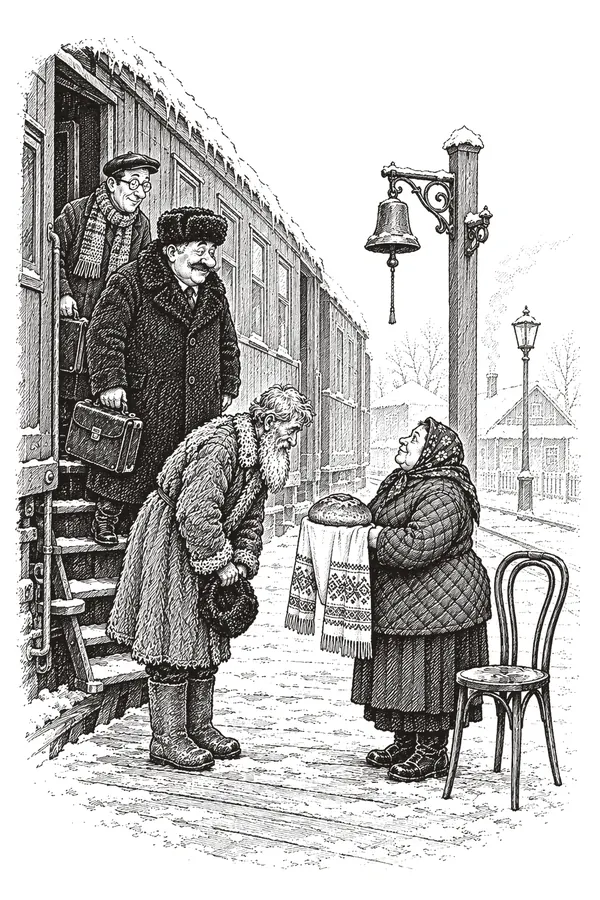
At nine o’clock sharp the morning train from the region brought two visitors: a plenipotentiary with a briefcase and the management’s son-in-law, also with a briefcase.3 On the platform they were met by the head of the town fund of direct acquaintances, who knew everyone and met anyone.3
The town took the visitors for Smenshchikov. Both of them at once. In ten minutes the artel became a model one: Yermolaich combed his beard, the postcards were sorted by view, the chair was wiped down. A new light bulb was screwed in at the office. Sovmeshchenko counted the till three times, twice as bookkeeper and once as head.
The visitors shut themselves in the office with Podyskin. The meeting lasted four and a half hours and another seven minutes for tea.3 Tea was served first, as was the custom in Smeninsk in any difficulty. They talked about continuity: the visitors wanted to know who would succeed whom, Podyskin who would sit on the chair, and the head of the fund who knew whom. By the third hour everyone agreed that the question was important. The neighbouring artel Eurovid, from across the river, did not sit at the table but was kept informed: its representative stood in the corridor for all four and a half hours and learned everything through the door.3
At a quarter past six, to the minute, the visitors left on the evening train. From the step the plenipotentiary said:
“I think progress was made today.”
“We have already fixed the next meeting,” added the son-in-law. “Eurovid will join it.”4
The minutes recorded progress. What had been discussed, the minutes did not record. The chair was left on the platform. The head of the fund of direct acquaintances watched the train go and entered both visitors among his acquaintances.
V. THE VISION
At this point Aristarkh Alfonsovich Formatov, chairman of Eurovid, returned from a district meeting in Dubovka.5 Eurovid printed postcards too, but it sold not views but a vision. Over its porch hung a signboard:
EUROVIDVision by subscriptionFirst monthcharged extra
Formatov inspected the chair and the Vidokarta postcards and said:
“Not at all bad for your latitudes.”
It was said the way one praises a drawing of a horse with five legs: sincerely, and in the hope that the fifth will be removed in time.
Then he announced that first of all one must have a clear and united vision of what one wants for the artel and for oneself.5
“Content determines format,” he said. “I shall always be ready to work on these questions.”5
The town understood that the candidate had put himself forward. The chair was discussed until dusk: how high, with or without armrests, who sits on the right and who serves the tea. The format was being determined; the content waited. Formatov proposed discussing the chair in an enlarged format, with representatives of both banks, and promised to send the vision by Monday.
While the format was being determined, Angelina Fyodorovna sat down on the chair: in the evening she had to balance the till, and there was nothing else to sit on at the platform. The till balanced. There was no disruption. The board resolved to regard this as activity without disruption.
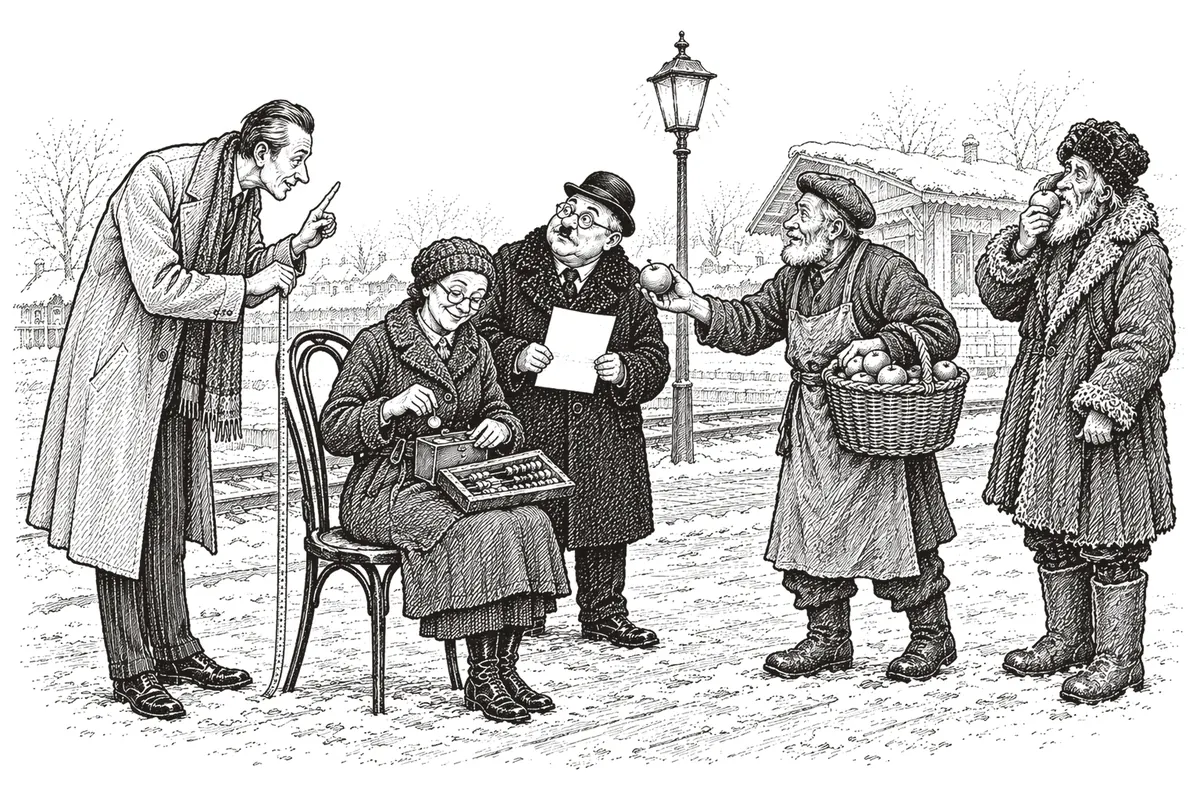
Then Smenshchikov came. He came not from the platform, where he was expected, but from the direction of the orchard, with a basket of Antonovka apples. He handed apples to everyone: Podyskin, Yermolaich, Sovmeshchenko, and Formatov too, with no subscription and no receipt.
“Will you be chairman?” asked Yermolaich.
“The orchard has stood here for a hundred and twenty years,” Smenshchikov answered. “And it has no plans to move to the board.”
Formatov took an apple, thought, and asked what its format was. He was told: Antonovka. Yermolaich ate his apple whole, format and all.
VI. THE TIMETABLE
In the evening someone pencilled “temporarily” above the word “permanent” on the notice. Podyskin thought about it and did not rub it out. Below it he pinned up a timetable:
FOR TOMORROW9:00 train from the region9:05 meeting with the candidate13:30 meeting continued18:15 progress
Yermolaich read the timetable twice and asked at what hour, according to it, progress would be made. He was shown the last line. He nodded: in Smeninsk progress had always come with the evening train.
The chair was returned to the office. On it sat Sovmeshchenko, balancing the till: as bookkeeper, as head, and as the only person who that day had somewhere to sit.
Podyskin stood in the doorway, looked at the chair, at the till and at the bookkeeper, put on his hat and went to the station to meet tomorrow’s train in good time. This time he did not take the chair with him.
Tomorrow at nine o’clock sharp the train from the region will come in. On the post by the market in Smeninsk a notice will be hanging since morning.
From press reports
Sources (RBC, 12 November 2026; in Russian):
- Nvidia’s head resigns after a scandal over two affairs — rbc.ru/business/12/11/2026/6af5c425e76a205052e8e498
- Trump proposes Tim Cook to head Nvidia — rbc.ru/business/12/11/2026/6af5df03acaa78c33f9503c0
- “Progress has been made”: how Putin’s talks with Witkoff and Kushner went — rbc.ru/politics/12/11/2026/6af4ced47b61ac853b47e223
- Witkoff announces new talks on Ukraine with Europe taking part — rbc.ru/politics/12/11/2026/6af5e0fc9e4e3811d73a4d1a
- Macron answers the idea of becoming a negotiator with Russia — rbc.ru/politics/12/11/2026/6af5e11df575de2e6f5a5721