FEUILLETON
HARD TO OVERESTIMATE
A tale of one antenna, one communiqué and one agent, as told by eyewitnesses and the newspapers
I. THE LETTER
“Dear Editor, A resident of Pereotsensk writes to you. They say television has been invented in the world. Please let me know whether this is true, and if it is, why it does not reach us.”
Television really did not reach Pereotsensk. The signal travelled forty kilometres from the regional centre and got stuck on the last three hundred metres, behind the bathhouse. The importance of this fact could hardly be overestimated in town, and nobody overestimated it: they looked out of the window.
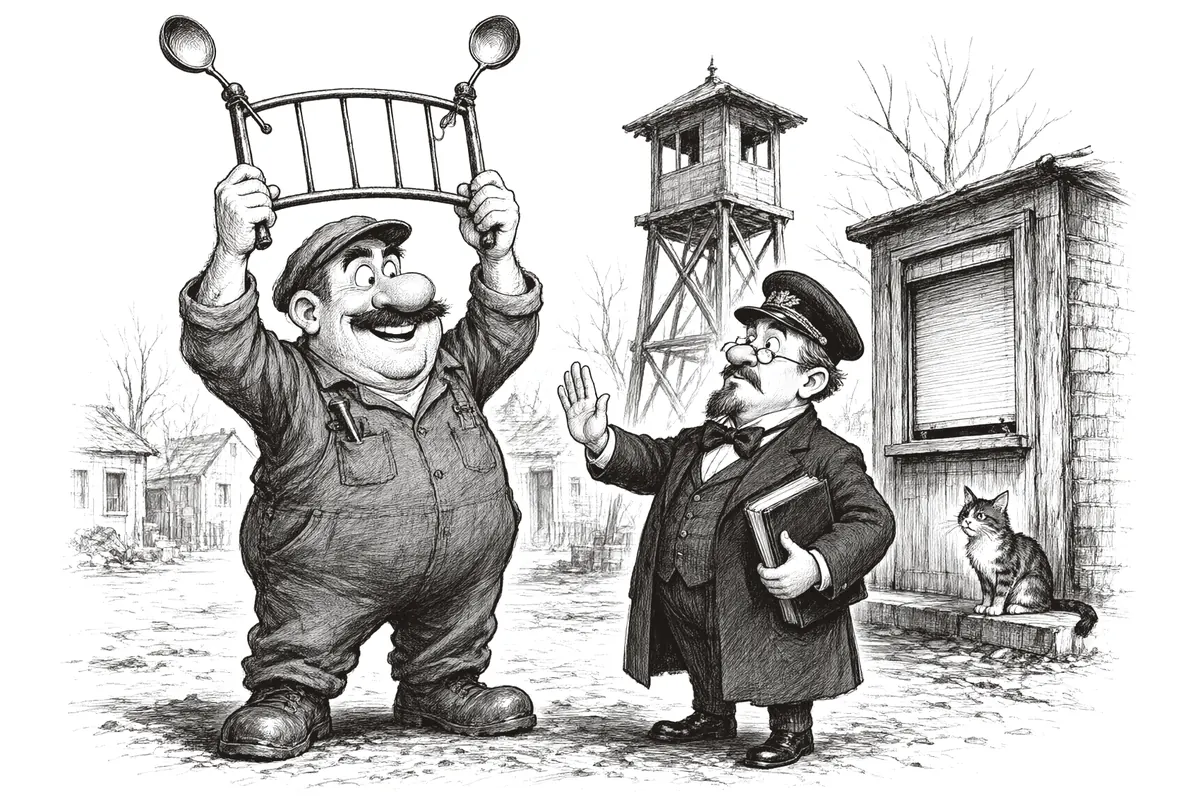
The club mechanic, Gavrila Simvolov, decided to put it right. He built an antenna out of a bed headboard, two soup ladles and patience. His aim was clear: on Saturday he would show the whole town the new foreign agent who had just been confirmed in the role.1
In his way stood Amvrosy Pravoobladatelev, general director of the Franchise cinema booth. The booth had one projector, one bench and one director, but a general one. He held the town’s rights to everything that moved on a screen.
“The agent can’t be shown without the franchise,” he said. “The rights have been bought.”
“By whom?”
“By abroad. For twenty million.”1
“And us?”
“You get tickets. When there’s a signal.”
II. THE BOARD
The antenna had to go up on the fire tower, and the fire tower had to be cleared with the club’s board of directors. The board had three members: Pravoobladatelev, the bookkeeper and the carpenter, Sanktsionov. It took its decisions not without a certain reluctance, but unanimously.
On Monday the carpenter was put on a list. The list was drawn up by the Euroclub from across the river: another hundred and forty-five people were on it too, the bath attendant and, by mistake, the bathhouse.2 Sanktsionov read the list, sighed and left the board.
The club at once put up a statement: the change in the board did not affect operations.2 This was true. The club’s operations were carried out by Sanktsionov alone, and he had just left.
“Will you give me the tower?” Gavrila asked those who remained.
“The board is incomplete,” said Pravoobladatelev. “There’s nobody to decide.”
“But there are two of you.”
“Two isn’t a board. Two is a conversation.”
Gavrila decided not to wait for a full board. That evening he called on Sanktsionov: a former board member no longer had to clear anything and was entirely free.
III. THE COMMUNIQUÉ
On Tuesday the parties sat down to draft a joint communiqué.3 Pravoobladatelev opened the meeting by saying that its importance and symbolism could hardly be overestimated. In Pereotsensk they said that about everything, the weather included.
By lunchtime the document was ready:
JOINT COMMUNIQUÉ1. The antenna is recognised as an antenna.2. The signal, if it comes,is common property.3. Showings by right of the rights holder.4. If the communiqué is not adopted,each party will give its own assessment.
Everyone signed. Each signed only point four.3 The bookkeeper, to be safe, signed it twice, for himself and for the departed Sanktsionov.
“Why only point four?” asked Gavrila.
“It’s the only one that promises nothing,” Pravoobladatelev explained.
“The agent is worth it,” said Pravoobladatelev, and read out from a foreign magazine that the new agent was “the most sought-after film star of 2026”.1
“We’ve got our own,” said the bookkeeper. “The Pole Star.”
“What’s it sought after for?”
“People find their way home from the dances by it. Two years running.”
“And are there rights to it?” asked Sanktsionov.
“Not yet,” replied Pravoobladatelev. “We haven’t had time to register them.”
IV. SATURDAY
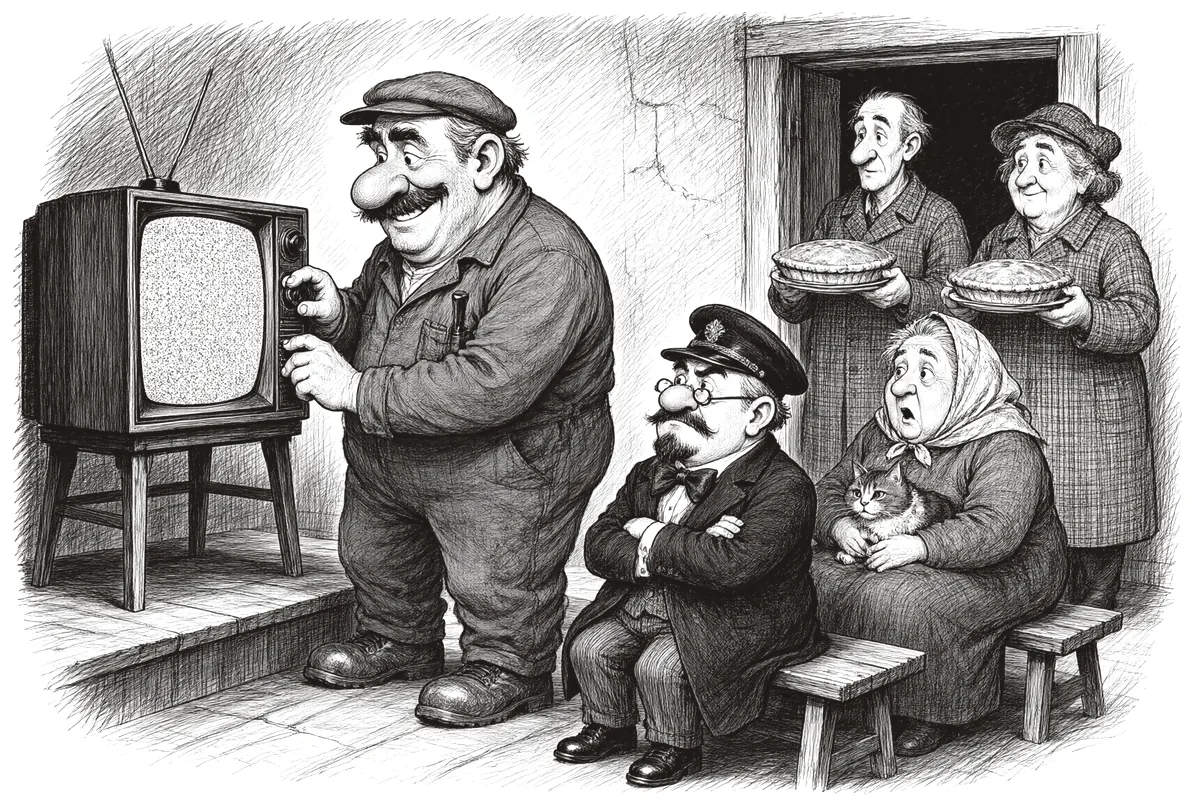
On Saturday the whole town sat in the club. The television was put on the stage, on a chair, so that it could see the hall. Gavrila turned the knob, Sanktsionov held the antenna on the fire tower, and the screen showed snow, even as in November and just as free.
The Euroclub came from across the river. It was seated by the door: present, but not taking part. Taking part would be considered if the guests made substantive proposals.4
“We’ve brought pies,” said the Euroclub.
“Substantive,” the hall agreed, and moved up.
They waited an hour. The signal came the way trains came to Pereotsensk: on schedule, but from the wrong side.
“Maybe turn the knob harder?” someone in the hall asked.
“You don’t turn it harder, you turn it longer,” Gavrila replied. “Force doesn’t help here. Character does.”
The town agreed to wait longer: in Pereotsensk they loved the waiting more than what they waited for.
Then Sanktsionov, who no longer had to clear anything with anyone, turned the antenna at random, towards the bathhouse. The snow on the screen parted. Out of it stepped the agent, in a dinner jacket, with a pistol and the face of a man who has just been confirmed.
V. THE NOTICE
“Switch it off,” said Pravoobladatelev. “There are no rights.”
“There are,” said Gavrila. “Point two: the signal is common property.”
“And point three?”
“You didn’t sign it.”
Pravoobladatelev thought it over and sat down in the front row. From that minute he regarded the front row as his operations.
Gavrila threw open the club doors and let everyone in free: the town, the Euroclub and the cat. No tickets were printed, no pies were counted.
“Quite right!” said the hall.
“And the rights?” asked the cat’s owner.
“We hold the rights to the stars,” Gavrila replied. “Nobody has bought them yet.”
Over Pereotsensk the stars came out, large and unhurried, the kind that only shine over towns without television. A week later, though, nobody saw them any more: in the evenings they watched the agent.
On the cinema booth, over the sheet that said “Showings by right”, a new one was pasted: “Showings by weather. Do not touch the antenna, Sanktsionov is holding it.”
And a letter came to the editor: “Dear Editor, Television has reached us. Now we can’t reach anything else.”
From press reports
Sources (RBC, 16 November 2026, in Russian):
- Robert Pattinson confirmed as the new Bond. First photo and video — rbc.ru/technology_and_media/16/11/2026/6afb1d74422e2c05bc3bd892
- Alexander Chachava leaves the Yandex board of directors — rbc.ru/business/16/11/2026/6afb11538ed362bb3f98cea7
- Ushakov reveals details of the coming Putin–Trump–Xi talks — rbc.ru/politics/16/11/2026/6afaf809dc023dc409ee6429
- Trump believes Russia is not acting at full strength in Ukraine — rbc.ru/politics/16/11/2026/6afb179456e36efe9fcd03c4