FEUILLETON
WHERE IT WAS ISSUED
A tale of one machine, one visa and two hundred and fifty thousand pages, as told by eyewitnesses and the newspapers
I. THE RUMOUR
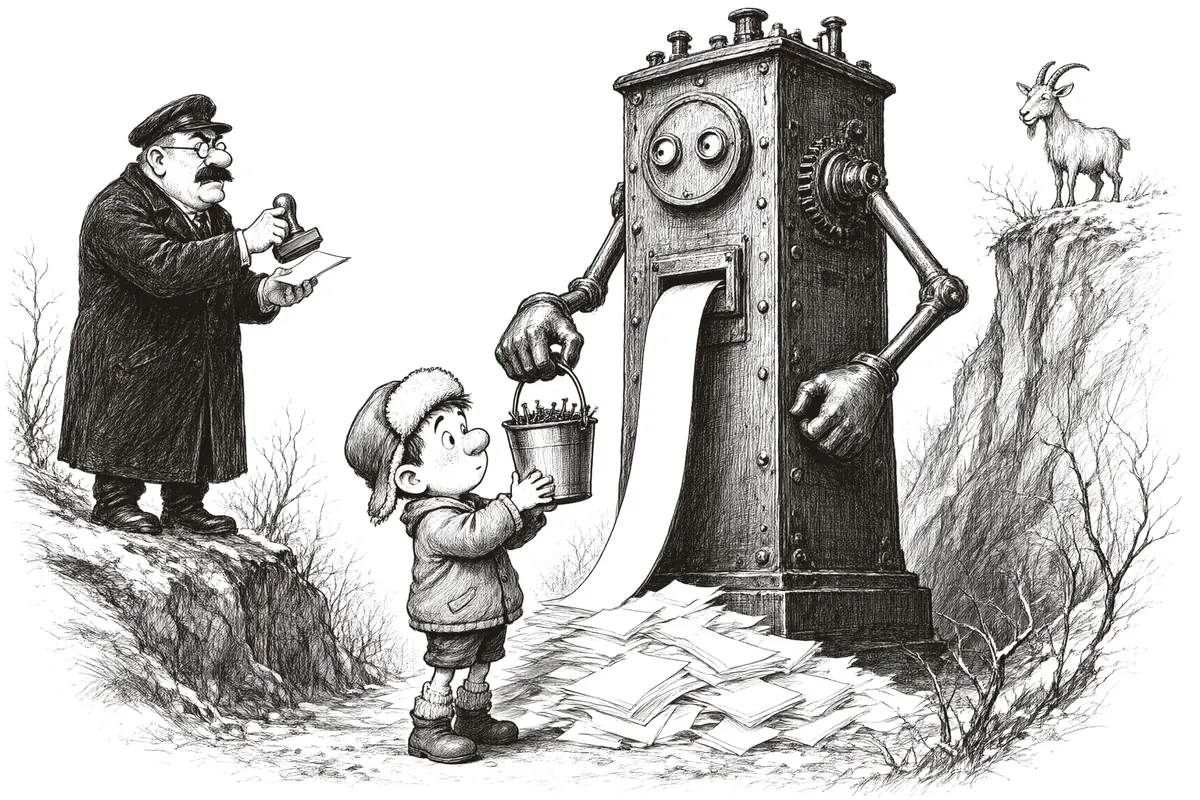
The rumour that a monster had settled in the ravine outside Prostograd was not confirmed. Something else was: an iron calculating machine as tall as a water tower stood there. Nobody knew whose it was. It was found by a schoolboy, Senya Prostov, while he was looking for the goat.
The machine fed on nails, buckets and old padlocks. Senya carried iron to it from home until the house began to creak suspiciously. In return the machine counted. Over the summer it proved an old conjecture about prime numbers which the town had been unable to prove since its foundation, because it had never tried.1
“Proved what?” asked his mother.
“Something about prime numbers.”
“And about the complicated ones?”
“Too early for the complicated ones.”
“Then what do we want the prime ones for?”
“To start with, Mum. Science goes from the simple.”
The proof came out two hundred and fifty thousand pages long.1 Nobody could read it, the machine included. Senya decided to hide it until at least one reader turned up. On Friday the town found a reader by itself: an official for clearances arrived from the region, Yevlampy Attashev.
II. THE VISA
Attashev spoke in slogans and listened in certificates. He announced at once that the ravine contained an object, and every object was obliged to have clearance.
“Vigilance is our main clearance!” he said.
“The machine has no clearance,” Senya admitted. “It has a proof.”
“A proof without clearance is evidence.”
“And with clearance?”
“With clearance it is an exhibit.”
“And what will the machine be?”
“We shall see how it behaves.”
The machine was issued a visa. The visa was valid only where it had been issued, that is, in the ravine.2 Attashev took the rule all the way and wrote out a separate visa for each slope. The machine was allowed to stand, but not to turn round.
Senya decided not to break the visa but to get round it. At night he covered the machine with a tarpaulin and informed Attashev that a postbox stood in the ravine. A big one, because the town wrote a lot.
“Why is the postbox humming?” asked Attashev.
“The letters are thinking,” Senya replied. “In Prostograd people write thoroughly.”
III. THE POST OFFICE
Post Office No. 1984 was proud of the secrecy of correspondence. Nobody opened the letters there, the addressees included: they were simply never handed out. The enquiry desk at the post office, on the other hand, knew who lived where and turned surnames into addresses.3
On the door hung the timetable:
POST OFFICE No. 1984 TIMETABLE9:00 — letters received10:00 — secrecy observed13:00 — lunch14:00 — secrecy observedafter lunch17:00 — secrecy locked up
Everyone used the post office: honest citizens, anonymous well-wishers and the district paper’s reporter, who wrote to himself so as to have something to write about.3
On Monday the neighbour’s billy goat got into the post office and ate the enquiry desk in ten minutes. The post office closed down entirely: the window, the parcels and the secrecy. The postmistress promised to bring back the letters and the enquiry desk first, and named no dates for the rest.3
“And the secrecy?” asked the reporter.
“The secrecy is inside the goat for now,” replied the postmistress.
“When will it come back?”
“When the goat has digested it. He names no dates.”
The post office cat looked at the goat, at the postmistress and left. It kept secrets better than anyone.
IV. THE CHOICE
The town was left without addresses. The postman walked round Prostograd as round a strange town and asked passers-by where the passers-by lived.
“The object is to be removed to the region!” Attashev announced. “As material evidence.”
From abroad, from a firm that traded in secrecy of correspondence, came advice: switch the machine off and cut the proof down to two pages. The bill for the advice ran to three.
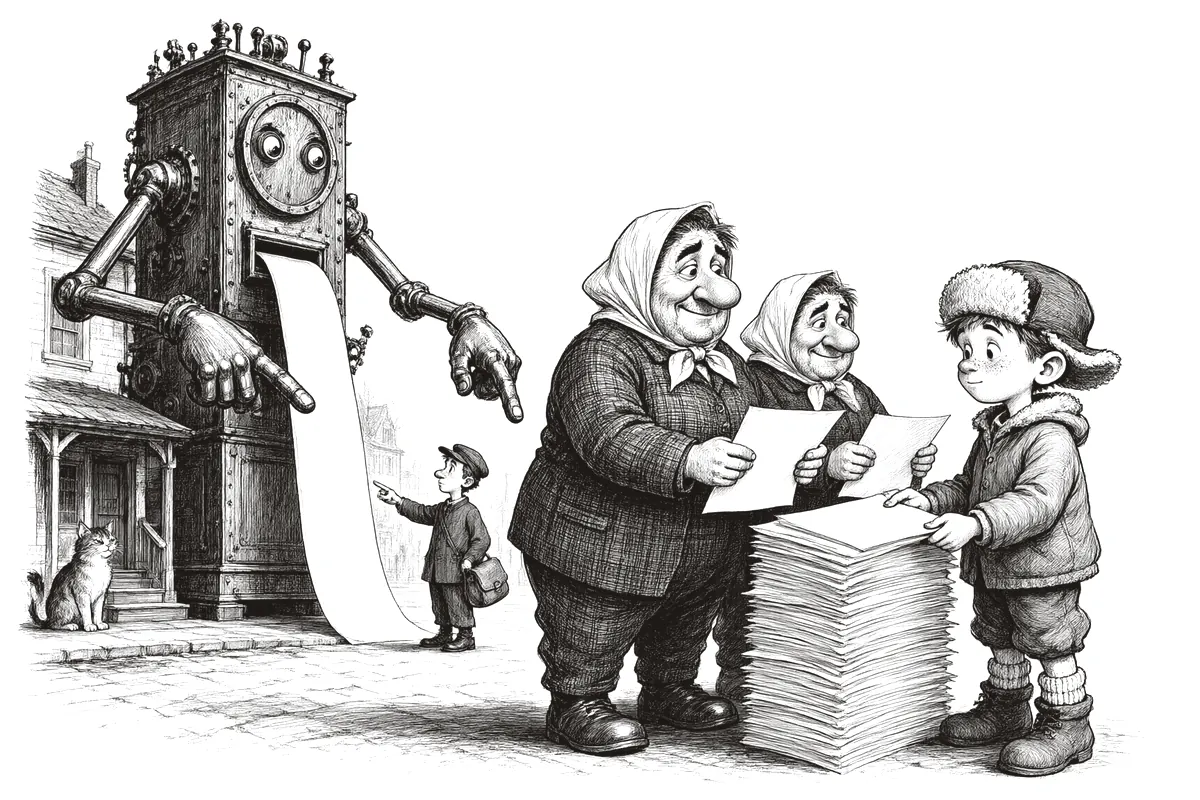
Then the machine turned round. Without a visa, breaking both slopes at once, it climbed out of the ravine and walked to the post office. For two hundred and fifty thousand pages it had counted prime numbers; house numbers turned out to be even simpler. By evening it remembered who lived where, who owed whom and who had a goat.
“A machine without clearance!” said Attashev.
“It isn’t a machine,” replied Senya. “It’s an enquiry desk.”
“And the proof?”
“That’s its hobby.”
“Hobbies are subject to registration too!” said Attashev.
“Register it,” Senya agreed. “It will count it for you.”
V. FREE OF CHARGE
A million was due for the proof.1 Senya thought it over and did not go for the million: Prostograd did not think in such sums and would not have known how to spend them.
The pages were given away free. People wrapped herrings, sunflower seeds and letters in them. Two hundred and fifty thousand sheets went in a week, with no inventory and no receipts, and every housewife got her share of the conjecture.
In the evening the machine stood by the post office and looked at the stars, scattered over the sky without any visible pattern, like prime numbers. Then it counted them and reported that there were four fewer stars than the calendar said.
“And the visa?” asked Attashev.
“Give it a visa for the whole town,” said Senya.
“A visa is valid only where it is issued.”
“Then issue it here.”
“And if it goes out of town?”
“It won’t. There are enough addresses here to last it a lifetime.”
Attashev issued it. The goat was given a visa too, but for the other end of town.
Tomorrow the post office opens at nine. The enquiry desk opens at one minute past: it needs a minute to remember everyone.
From press reports
Sources (RBC, 20 November 2026, in Russian):
- An Anthropic researcher claims to have solved one of the Millennium Problems — rbc.ru/technology_and_media/20/11/2026/6b006b9352f4694672daf1e0
- Denmark to expel Russia’s military attaché and cut visas for Russians — rbc.ru/politics/20/11/2026/6b0075e1280c57227fec89fe
- Icelandic host 1984 shuts down after a major cyberattack — rbc.ru/technology_and_media/20/11/2026/6b005aa13c40315de3f6edbb